
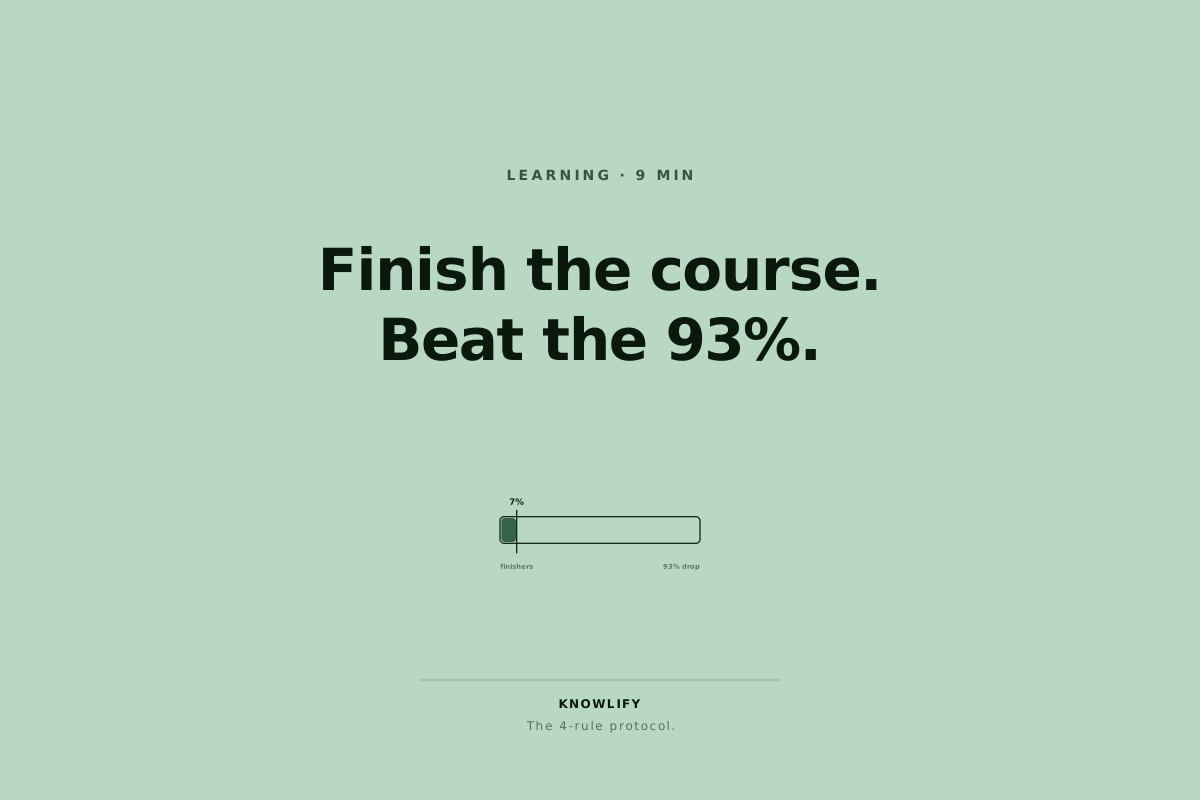
Why only 7% of people finish online courses — and how to be one of them.
Most courses get abandoned by week 3. The reasons are predictable, and the fix is more boring than you'd hope. Here's the protocol that works.
The number is well-documented and ugly: across major online learning platforms, about 7% of people who enroll in a course finish it. The rest drop off somewhere between video 3 and video 12, usually around the first hard assignment.
It's not because the courses are bad. Many are excellent. It's because the way most people approach courses sets them up to fail. The fix is small. Almost insultingly small. It's also the difference between "I'm taking a course" and "I'm finishing a course".
The actual reason most courses die
Not motivation. Not time. The reason is that learning by watching feels like learning, but it isn't.
You watch a video. The instructor explains a concept. You nod along. You feel like you understood. You queue up the next video. Two weeks later you can't actually do anything with the material because you never practiced. The "I'm not making progress" feeling kicks in. You stop opening the course. The end.
The break in the loop is between "watching" and "doing". Almost everyone's course-taking habit is watch-watch-watch-quiz-watch-watch. The pattern that works is watch-do-watch-do-watch-do.
The 4-rule protocol
Four rules. None of them are clever. All of them work.
Rule 1: Schedule it, like a meeting with yourself. Not "I'll do an hour when I have time". A specific 15-30 minute slot, repeating, on your calendar. Most people who finish courses report doing them in slots of 20-30 minutes, 3-5 times a week. Total time investment per week: 1.5-2 hours. The slot is the thing that makes it survive.
Rule 2: Do every exercise, even badly. Skipping the exercises is the single biggest predictor of dropping out. Even doing them sloppily — a half-attempted answer is better than no answer. The act of writing something down is where the learning lives. Watching is preparation; doing is the work.
Rule 3: Write one sentence at the end of each session. What did I just learn? In your own words. Not the instructor's words. Five seconds. Save it in a file. The file becomes a personal map of the course. By week 4 you'll have 12 sentences that summarize most of what you needed to know.
Rule 4: Build something with it. Don't wait until the course is "done" to apply what you learned. Use it on a real problem from your life or your job, in week 2. Even crudely. The link from "learning material" to "real use" is the thing that makes the learning stick. People who skip this step retain almost nothing six months later.
If you're behind by 3+ days, just open the course.
What "finishing" actually means
Here's a redefinition that helps: finishing a course doesn't mean watching all the videos. It means reaching the point where you can do, unprompted, the thing the course was teaching.
If you're taking a Python course, finishing means you can sit down and write a small Python program for a real problem, without consulting the course material. If you're taking a UX course, finishing means you can do a usability review on a real product.
This redefinition matters because it tells you when to stop. Most courses are 80% useful for what you need and 20% padding for the platform's content goals. You don't have to finish the padding. You have to reach the point where you can do the thing.
The pattern after the first course
The people I know who learned the most from online courses share a pattern: they finished their first one slowly and painfully. Then they got faster. Course five took half as long as course one, because they had built the protocol.
The first course you finish unlocks the next ten. The mechanics generalize. The discipline generalizes. The "I can do this" feeling — earned, not borrowed — generalizes.
Pick a course. Set the slot. Do the exercises. Build something. Finish. Then start the next one. That's the whole arc, and it's been the arc forever.