
MCP, explained the way I wish someone had explained it to me.
Model Context Protocol is suddenly everywhere. The marketing makes it sound complicated. The actual idea fits in one sentence.
MCP — Model Context Protocol — is the standard Anthropic shipped in late 2024 that quietly became important in 2025. The marketing copy makes it sound like a major framework. The actual idea is small. Once you see it, the rest is obvious.
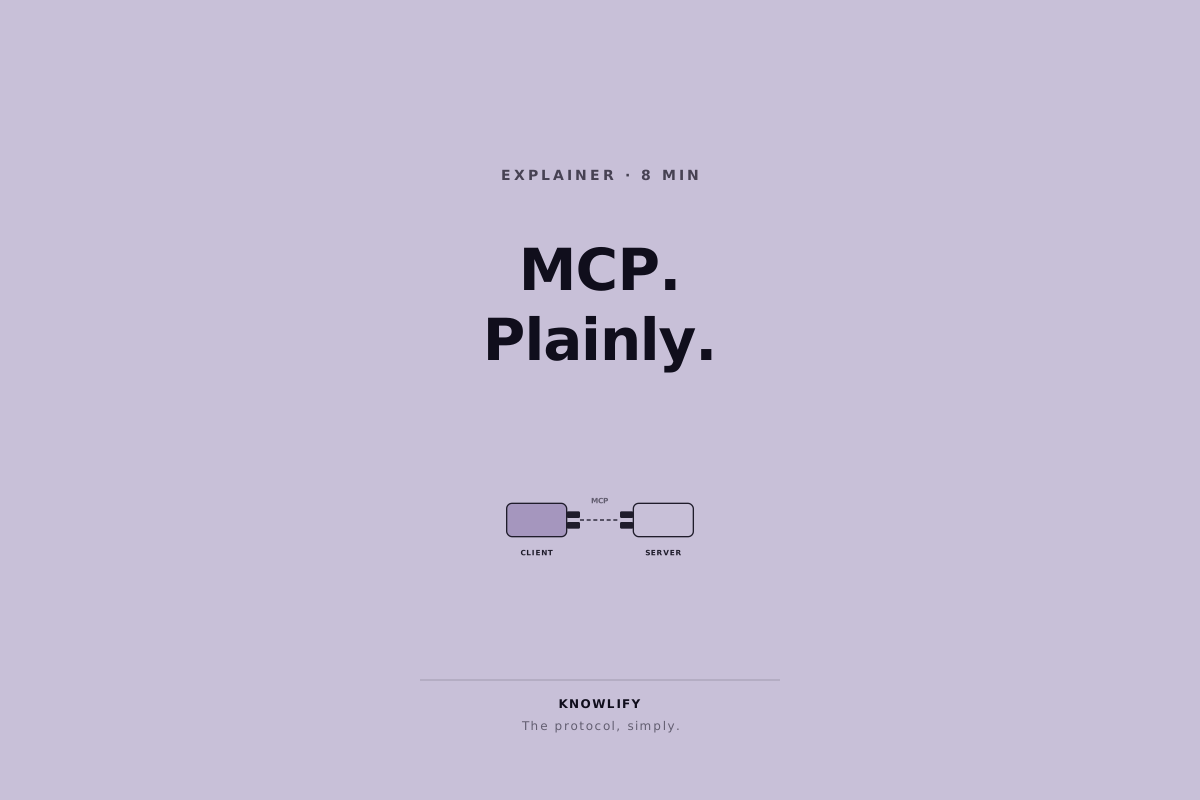
Here's the one-sentence version: MCP is USB for AI assistants. Any tool that speaks MCP can plug into any assistant that speaks MCP. That's it.
Now let's unpack why that matters.
The problem MCP solves
Before MCP, if you wanted Claude (or ChatGPT) to do something with an external system — read your Notion, write to your GitHub, query your database — you had to write custom code. Each integration was bespoke. Each model vendor had its own way of doing tools. You wrote it once for Claude, again for ChatGPT, again for the next one.
This was fine when you were building a demo. It became expensive once you had real systems. Every AI vendor reinvented the same wheel slightly differently, and every tool author had to ship the same integration N times.
MCP fixes this by being a small, boring standard. A tool author writes one MCP server. Any AI client that speaks MCP can use it. That's the whole game.
The architecture, in one image
That's the entire architecture. The client doesn't know what tools exist until it asks the server. The server doesn't know who's asking until the client connects. The wire format is JSON-RPC. The transport is stdio or HTTP. The whole spec is shorter than a typical README.
Why it matters in 2026
Three reasons.
One. It removes the lock-in. You can use the same MCP server with Claude today, switch to a different client tomorrow, and your integrations follow you.
Two. It makes the "marketplace" coherent. Anyone can write a server. Hundreds of them exist by now — for GitHub, Slack, Postgres, Figma, Linear, your home network printer, you name it. Most are MIT-licensed open source.
Three. It pushes complexity to the right place. Authentication, rate limiting, schema definitions — all live in the server, not in every client integration. The client just lists tools and calls them.
When to use it (and when not)
Use MCP when you're building anything that needs an AI client to do things beyond chat. If your app needs Claude or ChatGPT to read company data, run code, or take actions, MCP gives you the cheapest path with the least lock-in.
Don't use MCP for a feature where the LLM is just generating text and there's no external tool involved. You don't need a protocol for "ask the model a question and show the answer". The overhead isn't worth it.
The "is this for me?" test: do I want my AI assistant to call out to something other than itself? If yes, MCP is probably the right shape. If no, you're not in MCP territory yet.
The one-paragraph summary
MCP is a small protocol that lets any AI assistant use any tool without writing custom integration code for each pair. It's not magic. It's a JSON-RPC schema. Its importance comes from being boring enough that everyone agreed to ship it.
That's the whole thing. The framework videos can stop now.