
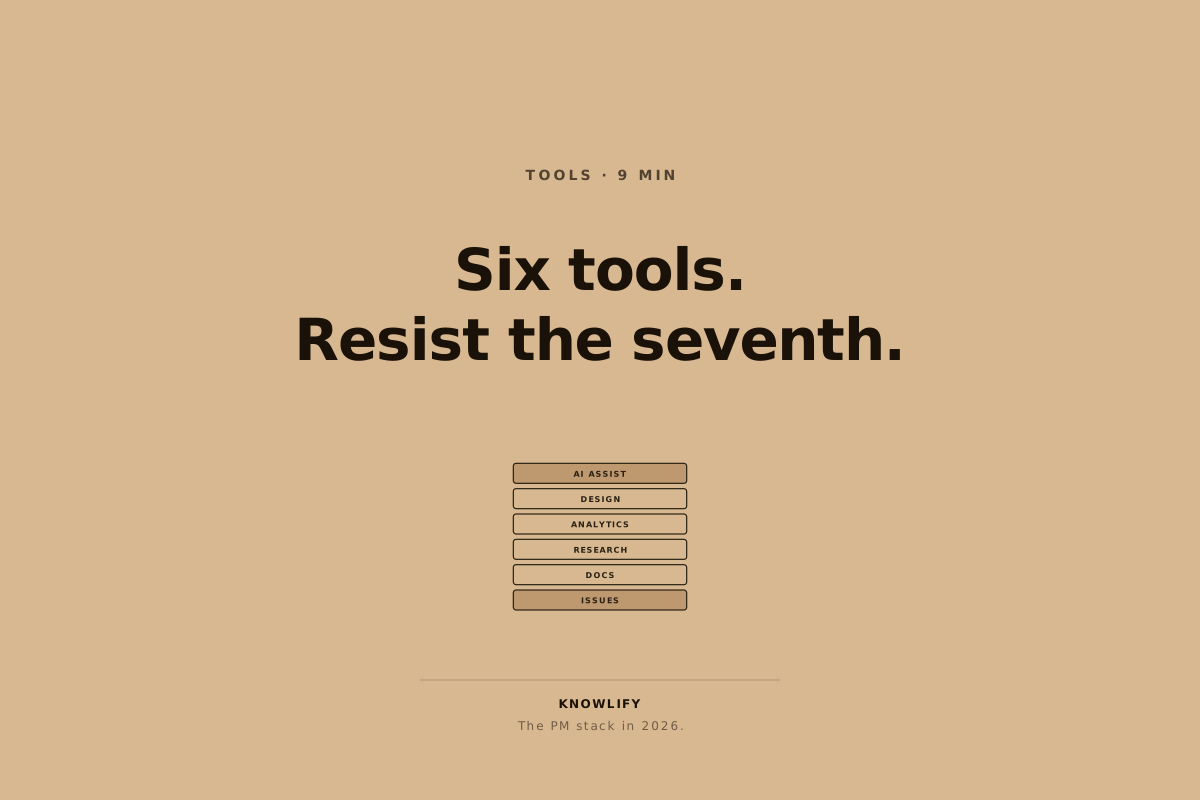
The product manager's tool stack in 2026.
You don't need 30 tools. You need 6 that actually do work, and the discipline not to add a seventh. Here's the stack that holds up.
PM tooling has gotten unhinged. The average product manager I've talked to recently uses 14 distinct apps in a typical week. Most don't even know they're using 14 — half of the tools are barely-used logins that came from someone's "have you tried" recommendation in 2023.
The honest stack you need is 6 tools. Each one does a specific job no other tool does well. Adding a seventh creates more friction than value.
Here's the stack.
The six categories
| Job | The tool | What it does |
|---|---|---|
| 1. Issue tracking | Linear | Where work lives. Tickets, sprints, status. |
| 2. Long-form docs | Notion or Google Docs | PRDs, OKRs, customer research, briefs. |
| 3. Quantitative analytics | Amplitude or Mixpanel | What users actually do. |
| 4. Qualitative research | Dovetail or Notion | What users actually say. |
| 5. Design + prototypes | Figma | Where mocks live; where comments happen. |
| 6. AI assistant | Claude or ChatGPT | Draft, summarize, restructure, brainstorm. |
What each one buys you
Issue tracking (Linear). Where work has a definition of done. Don't try to track work in Notion or Google Docs — they're not built for state machines. Linear is opinionated about workflow in a way that's correct for most teams.
Long-form docs (Notion or Docs). Where ideas, decisions, and context live. Not the same thing as tickets. PRDs, retrospectives, customer research summaries, OKRs. The choice between Notion and Google Docs is mostly about your company's existing default; the work is the same in either.
Quantitative analytics (Amplitude/Mixpanel). The behavioral data. "How many users actually use this feature?" "What's the funnel conversion?" Don't try to derive this from the database directly — you'll get bogged down in SQL.
Qualitative research (Dovetail or Notion). Where customer interviews, support tickets, and survey responses get synthesized. Dovetail is more specialized; Notion is fine if your team is small and you don't have hundreds of interviews to organize.
Design (Figma). Where designs live. PMs need to be in Figma daily — to comment, to look at flows, to grab screenshots for tickets. If you avoid Figma, you cede design decisions to whoever's loudest.
AI assistant (Claude/ChatGPT). The new sixth pillar. Used for: drafting comms, summarizing meetings, restructuring messy notes, exploring tradeoffs out loud, sanity-checking arguments. Not for "have it write the PRD" — that fails. For everything around the PRD, it's the biggest leverage tool a PM has gained in a decade.
Every new tool that gets pitched should answer the question: which of the six categories does it replace, and is the replacement actually better? If it's not replacing one, it's adding to your overhead. The right number of tools is the smallest number that does the work — not the largest number you can afford.
What's not in the stack
A few notable omissions, and why.
Roadmapping tools. Productboard, Aha!, Roadmunk — for most PMs, these add overhead without adding clarity. A Notion page with three columns (now / next / later) does 90% of what they do, with 10% of the maintenance burden. If your company already runs Productboard, fine, use it. If not, don't introduce it.
Customer feedback aggregators. Canny, UserVoice. These centralize feedback collection, which sounds useful but usually creates more channels of incoming volume, not fewer. Better to teach your support and sales teams to log feedback in a single shared doc.
Survey tools. Typeform, SurveyMonkey. You will run a survey maybe three times a year. Use the free tier of whatever's easiest. Don't add a recurring subscription.
Project management Frankenstein tools. Asana, Monday, ClickUp. These overlap with Linear and Notion in ways that mean you're not using either tool to its strength. Pick one tool for issues (Linear) and one for docs (Notion/Docs). Don't add a third that pretends to do both.
The stack-resistance principle
Every quarter, someone will pitch your team on a new tool. The pitch will be compelling — it always is. Most of the time, the new tool doesn't earn its place against the existing six.
The rule that holds the stack stable: before adopting a new tool, run it for 30 days as a pilot, then have everyone on the team explicitly answer "did this make my work better?" If the answer isn't a clear yes from at least 70% of the team, drop it.
Most "we should try X" pitches die naturally at the 30-day review. The ones that survive are usually the ones worth keeping. The stack stays small. The work stays clear.
That's the whole framework.