
I shipped 17 projects with AI last year. Two made money. Here's why.
The fast-shipping AI builder fantasy is real. The fast-getting-paid part isn't. A brutally honest postmortem of what worked, what didn't, and what nobody warns you about.
Some friends asked me what I'd built last year, so I sat down and counted. 17 projects. I shipped 17 small SaaS-shaped things between January 2025 and January 2026. Most of them in a weekend each. None of them took more than two weeks.
This is the dream the AI-builder Twitter influencers keep selling: tools that make you ten times faster, so you can ship ten times more, so you can pick which one becomes your next career.
I want to write the version of that story that's actually true.
The 17
Here's the list, mercifully short:
- A Chrome extension that summarised long Slack threads
- A CLI that wrote conventional commits from your diff
- A side-of-the-page reading-time estimator for blog readers
- An AI-powered tab manager
- A "what changed in this repo since Friday" weekly digest
- A typo-fixer for engineering docs
- A meeting-notes-to-action-items converter
- A landing page generator that pulled from your GitHub README
- A daily AI-news email
- A Notion plugin that auto-tagged pages
- A pricing-page A/B test analyser
- A code-review reminder bot
- A standup-summary generator for async teams
- A Discord bot that explained Solidity contracts
- A Stripe-failed-payment recovery tool
- A "explain this PR" plugin for GitHub
- A weekend tool that turned my notes into LinkedIn posts (sorry)
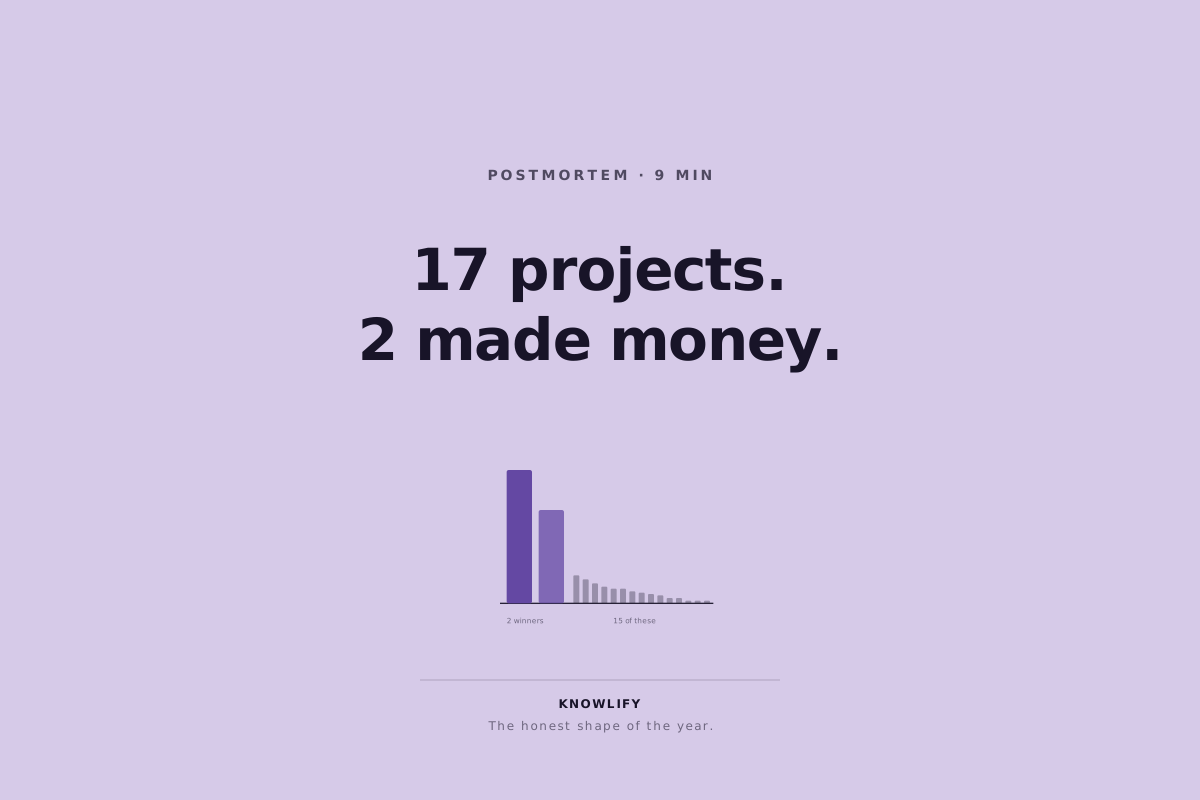
Two of them made money. The standup tool and the failed-payment recovery thing. The other 15 either got a handful of signups and died, or never got launched far enough to know.
Why most of them died
I'm going to skip the polite version.
Most of them died because shipping the thing was the only part I cared about. The thing itself, in most cases, didn't really solve a problem badly enough that anyone would pay for it. I built what was fun, what was technically interesting, what felt like a clever combination of recent papers. I did not build what was painful enough that a stranger would type their credit card number in to make it stop.
The AI tools didn't change that. They made me wrong faster.
| The 2 that worked | The 15 that didn't |
|---|---|
| Solved a problem I had myself | Solved a problem I read about on Twitter |
| Charged from day one | "Free, will monetize later" |
| Shipped in 2 weeks of nights/weekends | Spent 6+ weeks polishing before showing anyone |
| First 10 users were friends I asked directly | First 10 users were strangers from Product Hunt |
| AI helped me move faster on the boring parts | AI let me skip the part where I talk to a user |
What the 2 winners had in common
I went back and looked, because I genuinely wanted to know.
Both of them solved a problem I had personally felt at work that month. Not "I read on Twitter that people have this problem". I had been bitten by the problem myself. Recently. I knew the specific shape of the pain.
Both of them I'd already pitched to two or three people before writing a line of code. I'd asked "would you use this", they'd said yes, I'd asked them to commit to trying it, and they had. That's the boring version of customer development. It works.
Both of them I kept improving for at least three months. The 15 dead ones, I'd shipped, posted on Twitter, and then forgotten about by week two. Distribution isn't a launch. Distribution is showing up every week for a year.
Neither of them was the most technically interesting project I built. They were both, frankly, kind of boring.
What AI was actually good for
Not for finding the right idea. It can't tell you what to build. It doesn't know your customer. It doesn't know what your specific market is starved for.
It was good for the part of building where I would have given up if I'd had to do it by hand. The third-pass UI polish. The auth flow I didn't want to write again. The integration with three half-broken APIs. The boring parts where projects normally die because the founder runs out of activation energy.
If you have a real problem and a real customer, AI lowers the cost of building. If you don't, it lowers the cost of confirming you didn't have one.
What I'd do differently this year
I'd cut the projects in half and put the saved time into talking to people. Out loud. On calls. Not in Discord servers full of other builders.
I'd kill projects that didn't have paying users by week four. Not "interested users". Paying users.
I'd let the model build the thing in a weekend. I'd spend the next six weekends finding people to use it.
Closing
Building has never been the hard part. AI made it less hard. The hard part is still distribution, still product-market judgment, still talking to strangers about money. The tools that ship 10x faster don't help you with any of that. They just make the moment of finding out you built the wrong thing arrive 10x sooner.
That's actually fine. It's even useful. As long as you don't mistake speed for progress.