
The math behind skill compounding nobody shows you.
"Daily practice compounds." Sure. But what does it actually compound to? Here are the real numbers, which are weirder and more motivating than the platitudes.
"Get 1% better every day and you'll be 37x better in a year." You've seen the math. It's a famous line from Atomic Habits. It's also, like most viral charts, doing some interpretive work the original author didn't quite mean.
Skills don't compound at 1% a day, smoothly, like compound interest. They compound in clumps, with plateaus, with leaps, and occasionally with regressions. But they do compound. And the real shape of skill compounding, once you understand it, is even more motivating than the smooth-line version — because it tells you what to do on the days that feel pointless.
Here's the version with the math, the shape, and the practical takeaway.
The actual curve
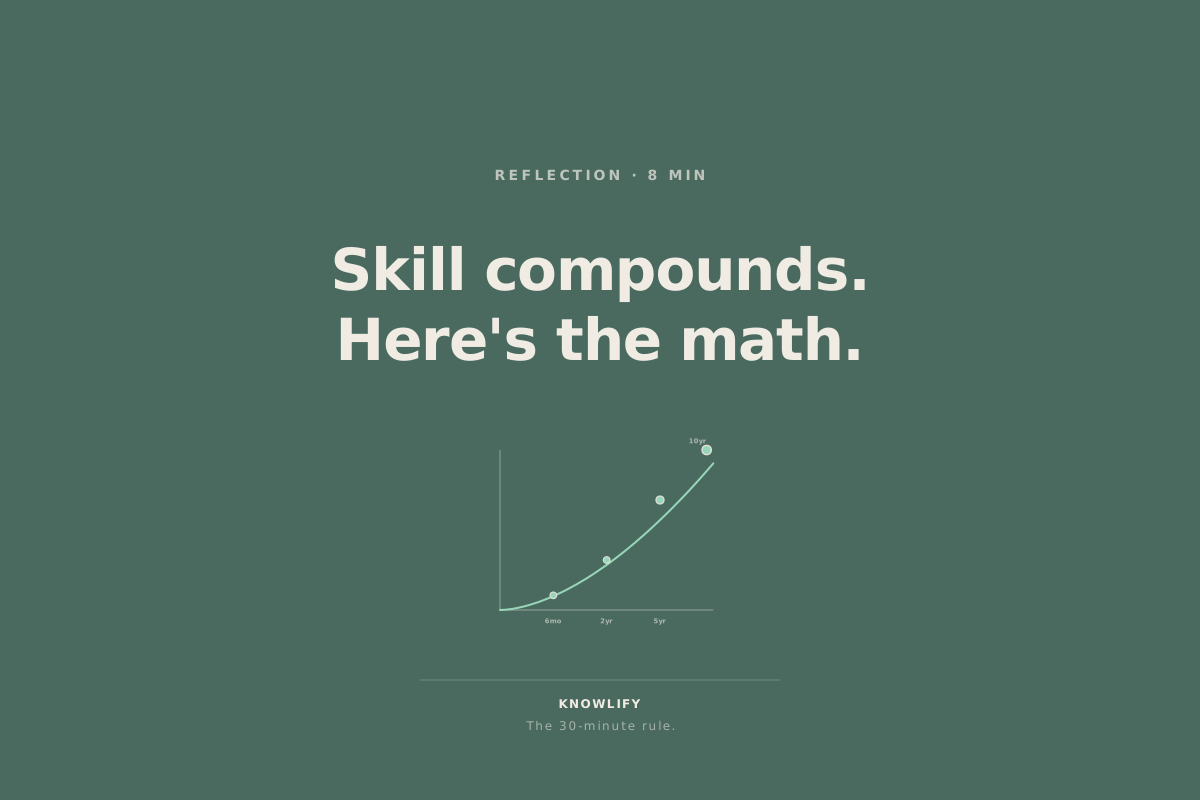
If you graph someone's skill development over time at almost anything — a sport, an instrument, a craft, a profession — you get something like this:
Months 0-3: rapid visible progress. Everything is new. You're absorbing fundamentals. Every week feels like a leap.
Months 3-6: the first plateau. The fundamentals are in. You haven't yet developed the deeper layer. It feels like you've stopped improving. Most beginners quit here.
Months 6-24: you start building real competence. The plateau breaks not because you're trying harder, but because the deeper patterns are starting to click. By month 24, you're hireable at a junior or mid level in most skills.
Years 2-5: the long climb. Slower visible progress, but the foundation deepens. By year 5, you're competent enough that most people in adjacent fields can't tell you apart from a master. You can.
Years 5-10: the differentiation phase. This is where mastery happens, for the small percentage who keep going. The compounding is slow but real. The gap between you and a 5-year practitioner widens, not narrows.
The motivational math
Here's the version of the math that actually matters. If you spend 30 minutes a day on a skill, for 5 days a week, for 10 years:
That's 39,000 minutes. About 650 hours of deliberate practice.
650 hours is enough to be in the top 5% of any skill that isn't elite professional. Programming languages. Writing well. Cooking. Photography. Public speaking. Negotiation. Drawing. Music at amateur level. Almost everything.
The 10,000-hour rule is real for elite mastery. But the 650-hour reality is that you don't need 10,000 hours to be in the top 5%. Most fields, the top 5% is at 500-1500 hours. Almost no one gets there because almost no one practices anything for 30 minutes a day for 10 years.
The reason isn't difficulty. It's that most people quit at the first plateau.
The plateau is not the absence of progress. It is the place where progress is happening underneath, where you can't yet see it.
Why daily beats weekly
The other thing the compound interest analogy misses: in skill learning, the cadence matters more than the total volume.
30 minutes a day for 7 days produces meaningfully more skill than 3.5 hours on one Saturday. Same total time. Different outcome. The reason is consolidation — your brain integrates skill during the time between practice sessions, not during the practice itself. More sessions = more consolidation = more skill per hour.
This is why "I'll do a big study session this weekend" almost never produces the results of "I'll do 30 minutes every weekday morning". Same hours, very different results.
The practical takeaway
If you want to develop a skill, here is the protocol that compounds. None of this is original. All of it is uncommon:
- Pick the skill. One. Not three.
- Set a 30-minute slot, daily, ideally same time.
- Practice deliberately — work on the part that's hard, not the part that's comfortable.
- Expect a plateau at month 3-6. Push through it. The plateau is the most important part of the journey.
- After 18-24 months, you'll be competent in a way that surprises you when you look back.
The math is not glamorous. The math is "30 minutes a day, every day, for a long time, on the hard parts". The math is enough. Almost no one does the math.
The people who do the math, do the math.